
How to Choose a Secure Multi-Tenant Analytics Platform for Your SaaS
Why Choosing the Right Multi-Tenant Analytics Platform Matters for SaaS
A multi-tenant analytics platform is software that serves multiple customers – called tenants – from a single shared infrastructure, while keeping each tenant’s data completely separate and private.
If you’re evaluating your options, here’s a quick breakdown:
| What to Look For | Why It Matters |
|---|---|
| Row-level security (RLS) | Prevents one tenant from seeing another’s data |
| Token-based auth (JWTs) | Ties every query to a specific tenant’s permissions |
| Metadata isolation | Hides even schema names from unauthorized tenants |
| Semantic layer | Maps user roles to data consistently across tenants |
| Hybrid tenancy support | Lets you scale small tenants cheaply and give large ones dedicated resources |
| Embedded dashboard support | Keeps analytics inside your branded product, not in a separate BI tool |
Most SaaS analytics teams start with a simple embedded dashboard. Then a second customer onboards. Then a third. Suddenly you’re patching row-level security in three different places, your BI tool’s permissions model doesn’t match your app’s auth system, and one misconfigured WHERE clause could expose one customer’s data to another.
That last scenario isn’t hypothetical. Without metadata security, connecting as one customer user can expose all other customer schemas in catalog query results – a real problem that teams using cloud data warehouses can run into when catalog visibility is not locked down.
The stakes are high. The U.S. average cost of a data breach hit $10.22 million in 2025, and more than 53% of all data breaches involve customer PII. In a multi-tenant environment, a single security gap doesn’t just affect one customer – it can affect all of them.
This guide walks you through the key architectural decisions, security requirements, and platform trade-offs you need to evaluate before choosing or building a multi-tenant analytics solution for your SaaS product.
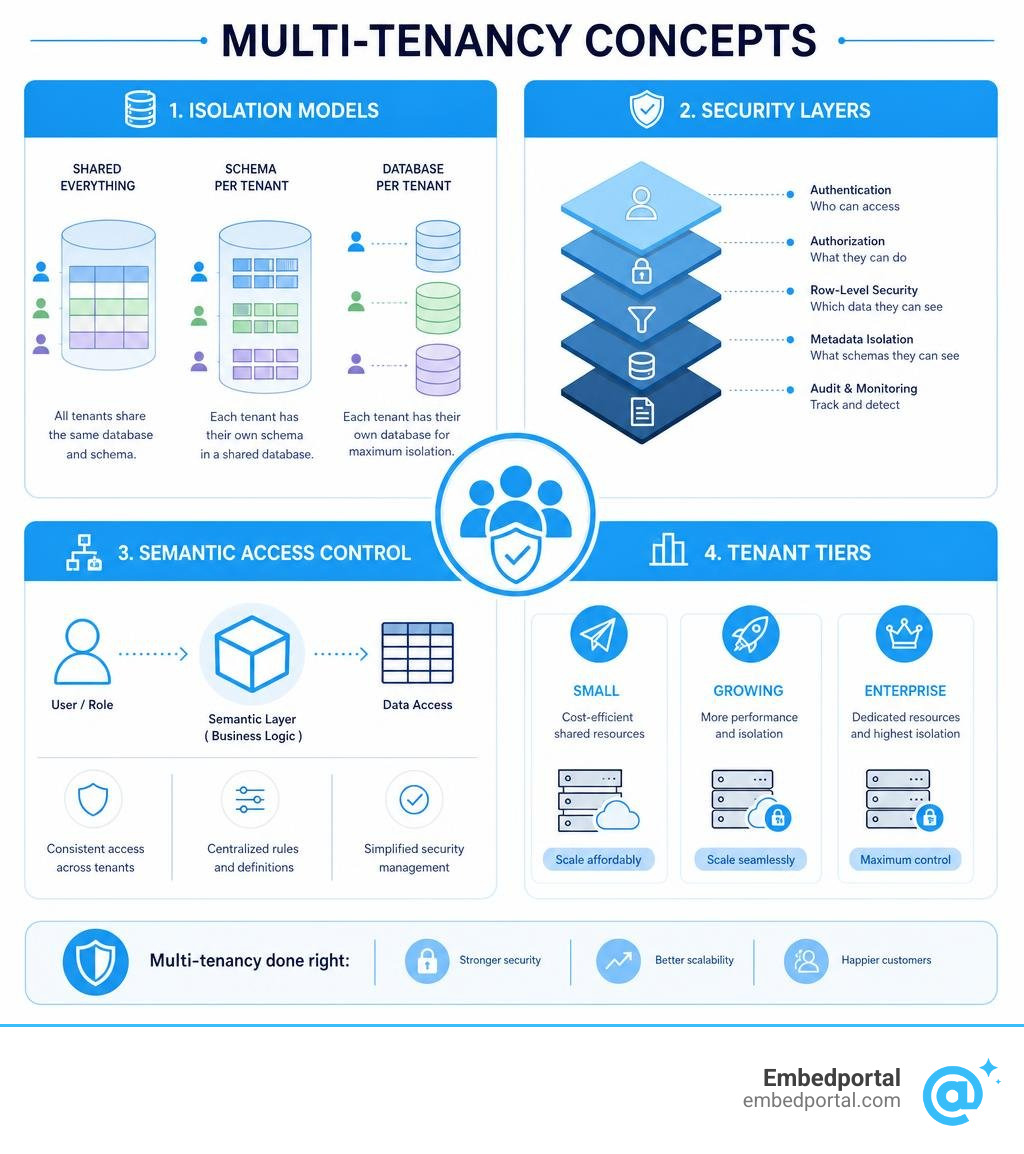
Terms related to multi tenant analytics platform:
Choosing a Secure Multi-Tenant Analytics Platform for Your SaaS
As we look at the state of software in 2026, delivering insights to your customers is no longer an optional feature. In fact, more than 50% of enterprises have implemented some form of embedded analytics within their operational platforms. At the same time, the underlying architecture has undergone a massive shift: over 82% of new analytics deployments are cloud-based, relying on auto-scaling, containerized environments.
When you are building or scaling a SaaS application, you have to decide how your users will interact with their data. Do you send them to an external, clunky BI portal, or do you integrate the charts directly into your software? The answer is almost always integration. To do this securely, you need a robust strategy for Embedded Analytics for SaaS.
Choosing a multi tenant analytics platform is not just about choosing a pretty charting library. It is about choosing how data is stored, queried, and isolated. You are tasked with taking complex, multi-tenant databases and serving them up to end-users without letting a single byte of Tenant A’s data slip into Tenant B’s browser. Understanding these foundational concepts is critical to shaping a secure and seamless user experience.
Architectural Patterns for Multi-Tenant Data Isolation
The foundation of any multi-tenant analytics platform is how it isolates data. There is no one-size-fits-all database architecture. Instead, you have to balance cost, isolation, and query performance.
Let us compare the three main architectural patterns you will encounter:
| Architectural Pattern | Cost Efficiency | Data Isolation | Query Performance | Management Complexity |
|---|---|---|---|---|
| Shared Database / Shared Schema | Extremely High | Low (Software-enforced) | Medium (Index-dependent) | Low |
| Shared Database / Multiple Schemas | Medium | Medium (Database-enforced) | High | Medium |
| Multiple Databases / Shared Schema | Low | Extremely High | Very High | High |
Choosing the right pattern is critical for your long-term scalability. If you want to dive deeper into how these models function at scale, check out our guide on Multi-Tenant Analytics and how to select the right Embedded Analytics Platform to match your choice.
Shared Database and Shared Schema in a Multi-Tenant Analytics Platform
In a shared database and shared schema model, all tenants store their data in the exact same tables. Each row of data is tagged with a tenant identifier column (such as tenantid or customerid).
This is the most cost-effective model because you only run and pay for a single database instance. However, security is entirely software-enforced. Every single query sent to the database must include a filter on the tenant ID column. If a developer forgets to append a WHERE tenant_id = ‘xyz’ clause to a query, you risk exposing one customer’s data to another.
Furthermore, this model is highly susceptible to the “noisy neighbor” effect. If one of your tenants runs massive, unoptimized reports, they can consume all available database connections and CPU cycles, slowing down the dashboard experience for every other tenant on the system.
Multiple Schemas and Dedicated Databases
To achieve stronger isolation, you can separate tenant data at the schema or database level.
In a multiple-schema architecture, tenants share a database instance but have separate logical schemas. This allows you to apply database-level permissions, ensuring that credentials assigned to Tenant A cannot access Tenant B’s tables.
Taking it a step further, the dedicated database model assigns a completely separate database instance to each tenant. This is the gold standard for security and performance. It is often mandated by strict compliance frameworks like GDPR, HIPAA, or PCI DSS. For instance, healthcare platforms isolating patient data often require schema-level or database-level isolation to meet HIPAA standards, while financial platforms handling credit card data use dedicated databases to comply with PCI DSS.
While dedicated databases offer the ultimate peace of mind, they are expensive and complex to maintain. Managing migrations, schema updates, and backups across hundreds of isolated databases requires significant engineering overhead. However, considering that the U.S. average cost of a data breach reached a record $10.22 million in 2025, and over 53% of breaches involve customer PII, the investment in strict isolation is often justified for enterprise-grade SaaS.
Hybrid Tenancy Models for Scalable Analytics
For many growing SaaS companies, the best approach is a hybrid tenancy model. This model allows you to balance cost and customization by categorizing your tenants into tiers:
- Shared Infrastructure: Smaller, free-tier, or self-service customers are grouped together in a shared-database, shared-schema setup to keep operational costs low.
- Dedicated Instances: Large, high-paying enterprise customers who demand strict compliance and custom data models are provisioned with their own dedicated schemas or database instances.
By adopting a hybrid model, you can scale your SaaS economically while still offering premium, isolated environments for customers willing to pay for them.
Enforcing Security and Mitigating the Noisy Neighbor Effect
When building user-facing analytics, performance and security must be solved together. If your analytics queries are slow, your user experience suffers. If your security is weak, your business is at risk.
To mitigate the noisy neighbor effect in a shared environment, you must implement workload isolation. This involves setting up query throttling, limiting concurrent connections per tenant, and utilizing analytical databases designed for high concurrency.
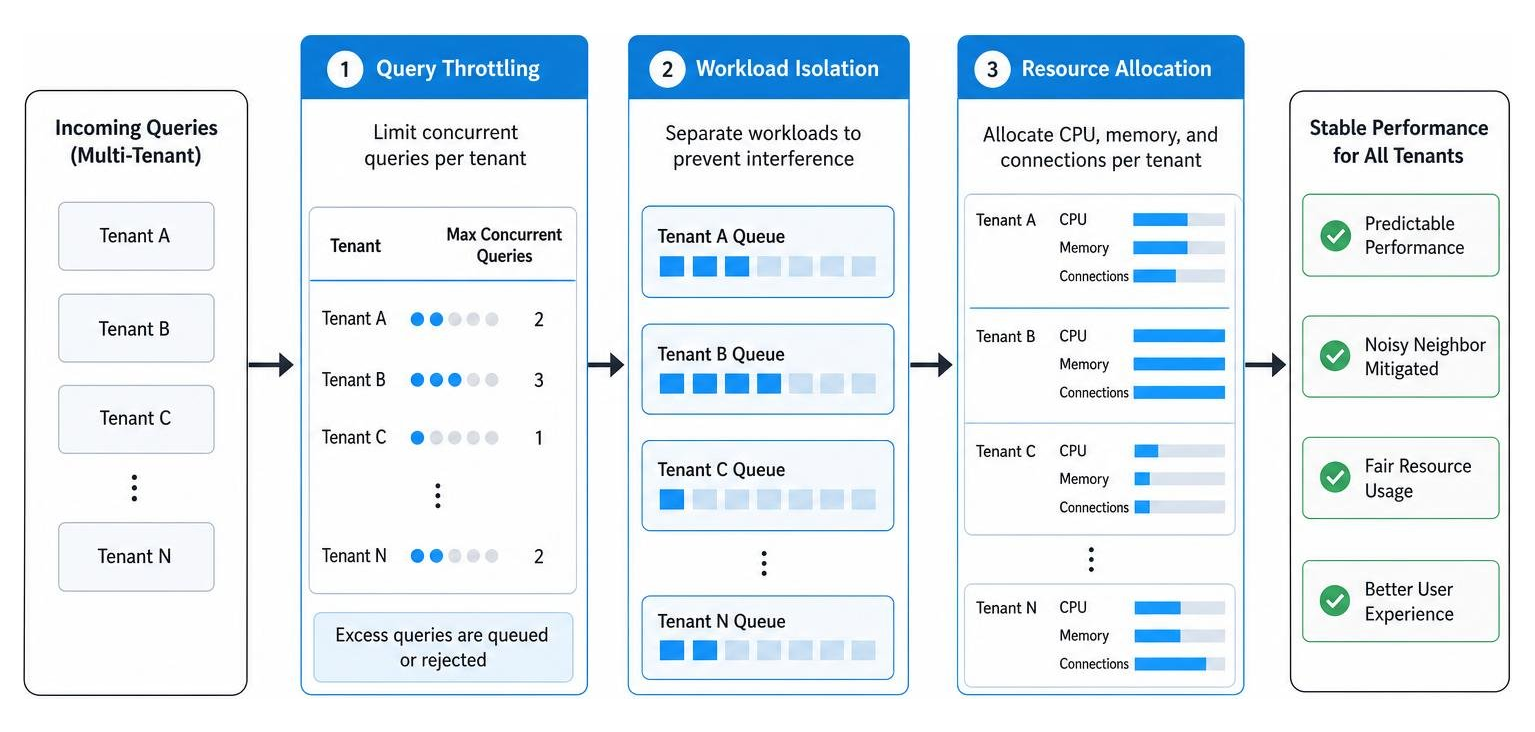
To learn how to lock down your data access layers effectively, see our technical breakdown of Multi-Tenant Row Level Security.
Row-Level Security (RLS) and Token-Based Authentication
For shared-schema databases, Row-Level Security (RLS) is your primary defense against data leakage. RLS ensures that the database engine itself filters out unauthorized rows before returning any query results.
To make this seamless, modern platforms use token-based authentication, such as JSON Web Tokens (JWTs). When a user logs into your SaaS application, your backend generates a signed JWT that contains the user’s tenant ID and permission scopes. The token format is standardized in the JSON Web Token standard.
When the frontend requests an embedded dashboard, it passes this JWT to your analytics engine. The analytics engine validates the signature server-side and uses the embedded tenant ID to apply RLS filters dynamically. Because the token is cryptographically signed, client-side users cannot manipulate URL parameters or query variables to view other tenants’ data.
To implement this securely in your data layers, check out our guide on Row Level Security and see how it integrates with Embedded Analytics workflows.
Metadata Security and Catalog Isolation in a Multi-Tenant Analytics Platform
Even if your data is isolated, you might still be leaking metadata. In some cloud data warehouses, catalog queries can expose the names of schemas and tables to connected users if metadata visibility is not restricted.
If Tenant A connects a BI tool directly to their isolated schema, they might run a catalog query and see schema names like tenantbprivatedata or tenantc_confidential. This metadata leakage can severely damage customer trust.
To prevent this, you must enable metadata security at the warehouse level where supported. Metadata security and catalog-visibility controls restrict database catalog visibility so users can only see metadata for objects they have explicit permissions to access. Hiding other tenants’ schemas entirely helps preserve privacy across the analytics environment.
Replicating Application Tenancy: Key Challenges and the Role of the Semantic Layer
Your SaaS application already has a complex web of user roles, permissions, and custom fields. Replicating this tenancy model within your analytics layer is one of the hardest challenges in BI.
If a customer admin adds a custom field to their workspace, your analytics platform must immediately recognize that field without requiring a manual database migration. If a user’s role is changed from “Admin” to “Viewer” in your app, their dashboard permissions must update instantly.
This is where a semantic layer or data dictionary becomes invaluable.

The semantic layer acts as an abstraction layer between your raw physical database and your presentation layer. It maps application-level user roles directly to database schemas and columns. Instead of writing complex SQL queries for every dashboard widget, you define your metrics, permissions, and relationships once in the semantic layer.
Modern data platforms simplify this mapping by utilizing warehouse-native architectures to handle dynamic data modeling and using a semantic layer to ground diagnostics without copying data.
By utilizing a unified semantic layer, you can easily map user groups and enforce access rules. To learn more about setting up these user permissions, read our guide on User Management for BI.
Build vs. Buy: The Hidden Costs of Custom Multi-Tenant Analytics
When adding analytics to your SaaS, the classic engineering dilemma arises: should you build a custom analytics solution in-house or buy a purpose-built platform?
Many software engineering teams choose to build. On paper, it looks simple: write some SQL queries, connect a charting library, and render the graphs on the frontend. However, this approach ignores the massive “engineering tax” of custom software.
Building a secure, scalable, multi-tenant analytics engine means you are responsible for:
- Writing and maintaining complex row-level security logic.
- Building caching and pre-aggregation pipelines to handle high query volumes.
- Creating a custom dashboard designer for users who want self-service reporting.
- Scaling database infrastructure to prevent noisy neighbor performance degradation.
This infrastructure work quickly drains your engineering resources. In the United States, the average salary for a specialized data engineer is approximately $134,656, compared to a general software engineer’s salary of $114,168. Forcing your software engineers to act as data infrastructure engineers is not only expensive, but it also distracts them from building your core product features.
To understand the full financial impact of this decision, review our analysis of Embedded Analytics Pricing. If you want to evaluate third-party options, you can read our list of the Best Embedded Analytics Tools and see how SaaS BI Embedding can accelerate your roadmap.
Frequently Asked Questions about Multi-Tenant Analytics
How do you prevent cross-tenant data leakage in shared databases?
To prevent cross-tenant data leakage in shared databases, you must enforce Row-Level Security (RLS) at the database level. Pair this with signed JSON Web Tokens (JWTs) generated by your application backend. The JWT carries the tenant’s secure session context, ensuring the database filters queries automatically and prevents users from accessing unauthorized rows.
What is the noisy neighbor effect and how is it mitigated?
The noisy neighbor effect occurs when one tenant runs heavy queries that consume shared database resources, slowing down performance for other tenants. It is mitigated by implementing workload isolation, query concurrency limits, database caching, and using auto-scaling, cloud-native data warehouses.
How does a semantic layer simplify role-based access control?
A semantic layer acts as a translator between your database and your dashboards. It maps application roles and tenant permissions directly to data definitions. This allows you to define security policies once at the semantic level and automatically apply them across all reports and user sessions.
Conclusion
Building a secure, performant, and scalable multi tenant analytics platform is a complex engineering challenge. You must carefully balance database architecture choices, implement robust row-level security, and prevent performance issues like the noisy neighbor effect, all while keeping your operational costs low.
At Embedportal, we help SaaS teams bypass the engineering tax of custom analytics. Our white-label embedding platform allows you to embed dashboards from multiple BI vendors directly into your application.
With Embedportal, you get unified branding, enterprise-grade SSO, and secure Row Level Security out of the box – allowing you to go from raw data to secure, customer-facing insights in under an hour. Let us handle the complex multi-tenant infrastructure so you can focus on building your core product.