How to Handle Secure BI Embedding Across Multiple Vendors
Why Multi-Vendor Secure Embedding Is One of the Hardest Problems in SaaS Analytics
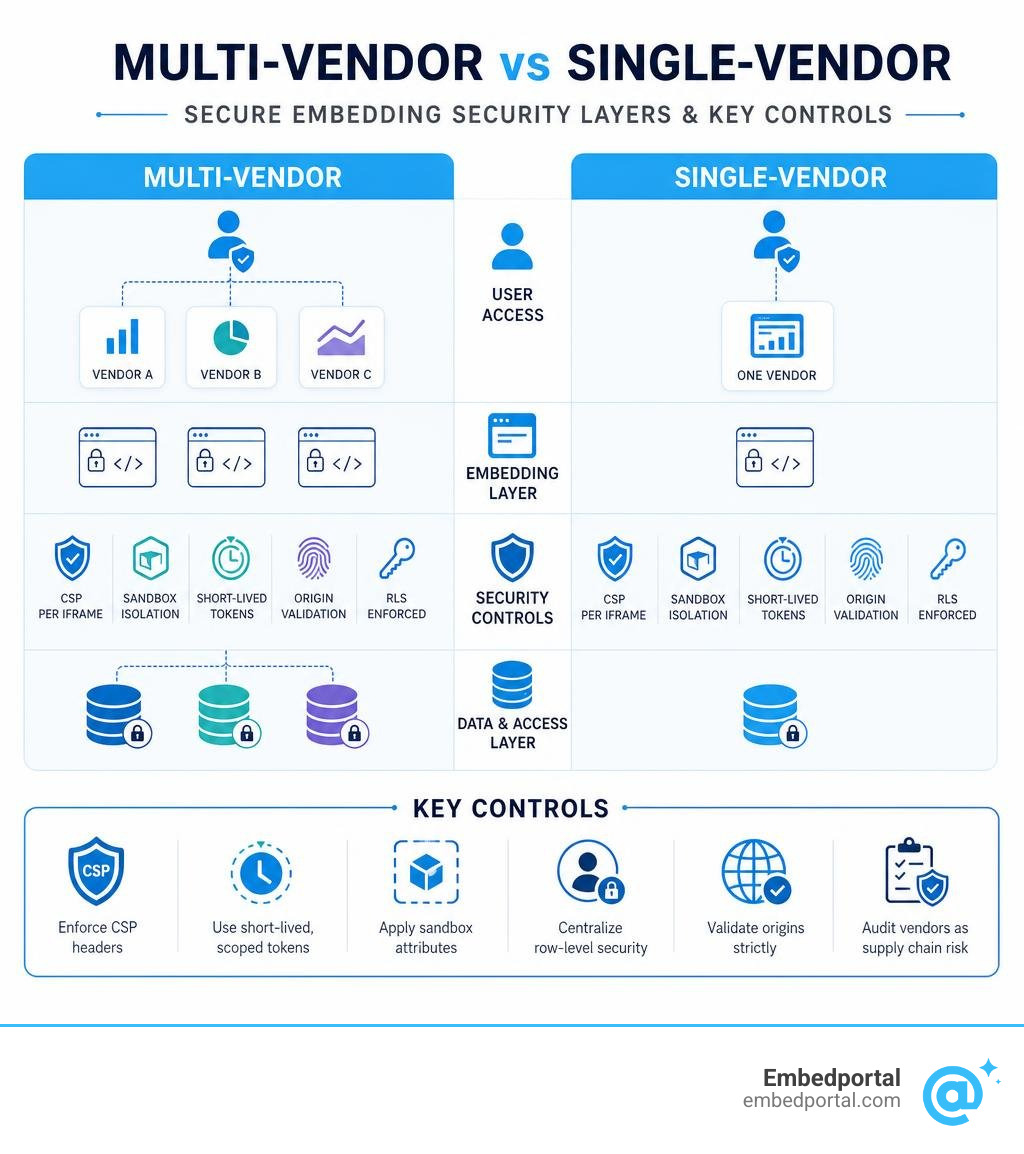
Multi-vendor secure embedding is the practice of safely integrating dashboards and UI components from multiple third-party tools into a single branded portal — while keeping data isolated, auth consistent, and security policies enforced across every vendor boundary.
If you need a quick answer, here’s what it takes to do it right:
- Enforce CSP headers on every iframe, including the
cspattribute for embedded enforcement - Use short-lived, scoped tokens (JWTs or UUIDs) — never expose long-lived keys to the browser
- Apply sandbox attributes to isolate third-party scripts and iframes
- Implement row-level security centrally, not per-vendor
- Validate origins strictly — exact scheme + host + port, no wildcards
- Audit every embedded vendor as a supply chain risk under NIS-2 and DORA
Here’s the reality most analytics and product leads run into: your customers want one seamless portal. But your stack has three BI tools, two data sources, and vendors who each have their own auth model, script delivery method, and security assumptions.
That gap — between what users expect and what vendors deliver — is where the real risk lives.
Attackers don’t care which vendor owns which iframe. As one security practitioner put it plainly: most companies aren’t under-secured because they lack tools — they’re under-secured because they have too many tools that don’t talk to each other. Fragmented policies, drifting configurations, and blind spots between vendors create exactly the kind of gaps that get exploited.
Third-party JavaScript embedded across multiple domains has been linked to credit-card theft, session hijacking, and data exfiltration. And when you’re embedding from multiple vendors simultaneously, each one adds a new attack surface — and a new set of compliance obligations.
This guide walks through every layer of the problem: browser-level controls, authentication flows, token management, security chaining, and compliance — so you can build a multi-vendor embedding architecture that’s actually defensible.
Basic multi vendor secure embedding vocab:
The Architecture of Multi Vendor Secure Embedding
When we design an architecture to support multiple analytics vendors inside a single host application, we are essentially building a multi-tenant gateway. In a single-vendor scenario, security is relatively straightforward: you establish a trust relationship between your host app and that one BI tool, configure your identity provider, and call it a day.
In a multi-vendor environment, however, the complexity scales non-linearly. We must deal with control-plane fragmentation. Each vendor (e.g., Tableau, Power BI, Metabase) expects to manage its own authentication sessions, CSS styles, and data access policies. Left unmanaged, this leads to policy drift — where security rules are updated in one system but forgotten in another — and highly vulnerable data leakage paths.
To build a robust SaaS BI Embedding system, we have to decouple the presentation layer from the data control plane. The host application must act as the single source of truth for identity, permissions, and security policies. The embedded components should only receive scoped, short-lived tokens that grant access to pre-filtered datasets. This is the foundation of secure Embedded Analytics.

Mitigating Script Risks with Sandboxing and Subresource Integrity
One of the biggest security risks in multi vendor secure embedding comes from loading third-party JavaScript directly into the parent window. If a vendor’s script is compromised, it gains full access to the Document Object Model (DOM), local storage, and session cookies of your host application.
To mitigate this, we must isolate third-party scripts. Where possible, use Subresource Integrity (SRI) hashes to verify that the scripts fetched from CDNs have not been tampered with. However, SRI becomes difficult to manage with live-updating vendor scripts that change without notice.
When SRI is impractical, nesting these scripts inside sandboxed iframes is our strongest defense. By applying the sandbox attribute, we can restrict what the embedded frame is allowed to do. For instance, we can selectively enable permissions like allow-scripts to run the analytics engine, but omit allow-top-navigation to prevent the frame from redirecting our parent application.
If we must allow the iframe to make API calls to its own domain while keeping it isolated from the parent, we can carefully combine allow-scripts and allow-same-origin. Utilizing framework-agnostic cross-domain component toolkits like krakenjs/zoid allows us to safely pass props and callbacks across these domain boundaries without manually writing complex, error-prone postMessage listeners.
Secure Communication Protocols and Cross-Domain Toolkits
Bi-directional communication is essential when you want your embedded dashboards to interact with your host application. For example, clicking a row in an embedded Metabase chart should update a filter in an adjacent Tableau frame.
Historically, developers hand-rolled postMessage listeners to achieve this. However, without strict origin validation, this introduces severe vulnerabilities. Attackers can easily spoof messages or intercept sensitive payloads. When using standard browser APIs, we must always validate the origin (event.origin) of incoming messages against an explicit allowlist of exact scheme, host, and port combinations.
To simplify this, modern architectures leverage standardized protocols and specialized toolkits. As mentioned, the krakenjs/zoid toolkit abstracts the postMessage layer, automatically exposing properties and callbacks in the iframe via window.xprops while maintaining secure isolation.
For commerce-focused or transactional embeds, emerging specifications like the Embedded Cart Protocol (ECaP), defined in the Embedded – Universal Commerce Protocol (UCP), demonstrate how hosts can safely embed a business’s interface and receive real-time events through structured, secure handshake messages and lifecycle notifications.
Advanced Browser Security: CSP and Embedded Enforcement
A robust Content Security Policy (CSP) is non-negotiable for multi vendor secure embedding. By default, CSP headers allow you to restrict where your host page can load scripts from (script-src) and where it can frame content from (frame-src or child-src).
To prevent clickjacking, we must also ensure our vendors set the frame-ancestors directive to explicitly allow our host application’s domain. Without this, malicious sites could frame your dashboards to hijack user clicks.
However, standard CSP only protects the host page. What happens inside the iframe is generally governed by the embedded document’s own policy. This is where the W3C specification for Content Security Policy: Embedded Enforcement comes into play. It allows our host page to mandate a specific security policy on the embedded document itself.
Through this mechanism, the host browser sends a Sec-Required-CSP HTTP header during the iframe navigation request. The embedded server must then opt-in by returning an Allow-CSP-From header and enforcing a policy that is at least as restrictive as the one required by the host. If the embedded server refuses or tries to load resources outside the mandated policy, the browser blocks the frame from rendering entirely.
Implementing the iframe csp Attribute in Multi Vendor Secure Embedding
To implement Embedded Enforcement in your application, you can use the csp attribute directly on your iframe elements. This allows you to define a tailored policy for each individual vendor.
When you define a policy via the csp attribute, the browser performs a process called policy subsumption and intersection. It ensures that the effective policy applied to the embedded frame is the intersection of what the host requires and what the embedded document itself requests.
This approach is highly useful when managing multiple vendors with varying resource needs. For example, a lightweight charting widget might only require access to a specific API endpoint, while a heavy BI tool needs to load scripts from multiple CDNs. By defining precise, vendor-specific policies in the csp attribute, you ensure that a vulnerability in one vendor’s frame cannot be used to exploit another.
This matches the strict standards outlined in the Embedded Apps Developer Guide – Zid Docs, which emphasizes utilizing explicit origin controls and strict CSP headers to prevent unauthorized frame rendering.
Authentication, Token Management, and Multi-Tenancy
When embedding dashboards for multiple customers, proper multi-tenancy and token management are critical to prevent data leaks. You must ensure that Tenant A can never view Tenant B’s data, even if they modify the iframe URL parameters.
The industry standard for secure embedding is to use JSON Web Tokens (JWTs). In this flow, your host application acts as the gatekeeper. When a user logs in, your server verifies their identity and permissions, then mints a short-lived, tenant-scoped JWT signed with your embed credentials. This JWT is passed to the vendor’s embed URL.
To prevent replay attacks, we should always store a unique token identifier (the jti claim) server-side and validate it on each request to ensure the token is only used once.
However, passing long JWTs directly in iframe URL query parameters can lead to issues. Some browsers or web servers truncate URLs if they exceed character limits (typically around 2,048 to 4,096 characters). To avoid this, some platforms utilize a token exchange flow.
As highlighted in the White-label embed | Rekomi Docs · Rekomi guide, you can generate a short, unique UUID lookup token server-side, map it to the user’s session and permissions in your database, and pass that lightweight UUID in the iframe URL instead. The embedded frame then exchanges this UUID for the full session context securely on the backend.
Implementing this across multiple vendors requires a unified Multi-Tenant Analytics strategy to ensure consistent token lifetimes and revocation policies.
Centralized Row Level Security and Data Isolation
To keep multi-vendor architectures maintainable, we must separate content security (who can see which dashboard) from functional security (what actions they can take) and data isolation (which rows of data they can query).
We strongly recommend implementing Centralized Row Level Security rather than configuring RLS rules inside each individual BI tool. If you attempt to maintain separate RLS configurations in Tableau, Power BI, and Metabase, they will eventually drift, creating massive security gaps.
Instead, your host application should inject tenant identifiers and user roles directly into the scoped embed tokens at runtime. When the embedded dashboard requests data, the BI tool passes these parameters down to your database or data warehouse, which enforces Multi-Tenant Row Level Security at the query level. This ensures that even if a user bypasses the front-end filters, the underlying data engine simply refuses to return unauthorized rows.
Chaining Security Functions and Managing the DAN Phenomenon
In a multi-vendor network, your data often flows through a chain of security and network functions from different providers (e.g., web application firewalls, API gateways, token translation services, and data masking proxies).
When chaining multiple security functions, organizations often fall victim to the “reDundancy security AccumulatioN” (DAN) phenomenon. The DAN phenomenon occurs when you estimate the overall security level of a service chain by simply summing up the security capabilities of each individual vendor function. This direct-summation approach is mathematically flawed and dangerous; it leads to an overestimation of actual system security, as it ignores the weakest-link vulnerability and the overlap of redundant controls.
To solve this, modern security engineering uses a Security Level Indicator (SeLI) to accurately calculate the effective security level of a chain. Rather than summing security levels, we must use logarithm-approximation algorithms to evaluate the true, non-linear security contribution of each node in the chain.
By applying a Security-Cost-Balance (SCB) factor, organizations can optimize deployment costs while meeting strict security requirements. In academic evaluations, utilizing advanced algorithms like the SSD-OSE (Security-aware Service function chain Deployment with Overflowing security level Elimination) has been shown to outperform traditional deployment benchmarks by an average of 18.42% to 67.77% in terms of cost-efficiency and security compliance. Applying these rigorous Row Level Security Best Practices helps you avoid false security assumptions.
Compliance Frameworks for Multi Vendor Secure Embedding
Operating in 2026 means navigating a highly regulated cybersecurity landscape. If you embed third-party analytics or security components in your SaaS application, those vendors are part of your digital supply chain, and you are responsible for their security posture.
Key regulatory frameworks you must consider include:
- NIS-2 Directive: Mandates that organizations in critical sectors perform comprehensive cybersecurity risk assessments of their supply chains and subcontractors.
- Digital Operational Resilience Act (DORA): Requires financial entities to maintain complete forensic logging and incident reconstruction capabilities. If a breach occurs, you must be able to prove exactly what data was accessed through your embedded dashboards.
- Cyber Resilience Act (CRA): Enforceable by 2027, this regulation requires all products with digital elements to undergo regular vulnerability reporting and security testing.
When selecting vendors, look for partners that offer robust, compliant foundations. For example, platforms running on secure, certified operating systems like those provided by Wind River Software | Safe, Secure, Reliable demonstrate the level of rigorous engineering required to meet modern compliance standards.
Centralized vs. Fragmented Security Stacks: Strategic Trade-offs
When designing your embedding environment, you will face a classic architectural choice: do you build a multi-vendor, “best-of-breed” security stack, or do you centralize on a single, unified platform?
Both approaches have distinct trade-offs:
| Security Stack Model | Pros | Cons |
|---|---|---|
| Centralized (Single-Vendor) | Simplified operations, unified telemetry, no agent conflicts, zero policy drift | Potential vendor lock-in, may lack niche features for specific BI tools |
| Multi-Vendor (Best-of-Breed) | Access to specialized features, avoids single point of failure, highly customizable | Control-plane fragmentation, high SOC burden, complex integration |
Centralizing your security stack on a unified platform drastically reduces operational complexity. When your identity, logging, and data access controls are natively correlated, your Security Operations Center (SOC) doesn’t have to piece together fragmented signals from five different dashboards at 3 AM.
However, if you must support multiple analytics vendors to satisfy diverse customer requirements, you should adopt a “platform + boosters” model. Use a centralized platform to handle the core identity, user management, and row-level security, and use specialized, vendor-specific boosters only where necessary.
Understanding the distinction between App Owns Data vs User Owns Data is vital here; it dictates whether your host application or the individual vendor platforms should hold the master credentials and manage data access policies.
Frequently Asked Questions about Multi-Vendor Embedding
What is the DAN phenomenon in multi-vendor security chaining?
The reDundancy security AccumulatioN (DAN) phenomenon is an error in security level calculation where the total security of a chain of service functions is calculated by simply summing up the individual security values of each vendor. In reality, security functions often overlap or depend on the weakest link, meaning direct summation overestimates protection. Proper estimation requires non-linear modeling, such as logarithmic approximation, to determine the true security level.
How do the Sec-Required-CSP and Allow-CSP-From headers work?
These headers are part of the CSP Embedded Enforcement specification. When a host page embeds an iframe, it can use the csp attribute to send a Sec-Required-CSP header containing the required security policy to the embedded server. The embedded server must agree to these terms by returning the policy in its Content-Security-Policy header, or by including an Allow-CSP-From header that explicitly permits the host to enforce the policy on its behalf. If these conditions aren’t met, the browser blocks the iframe from loading.
Why are UUIDs sometimes preferred over JWTs in iframe URLs?
While JWTs are excellent for passing cryptographically signed user claims, they can easily become very long, especially when they include complex user attributes and permissions. If a JWT is appended directly to an iframe URL query parameter, it risks exceeding the browser’s URL length limit, leading to truncation and loading failures. Using a UUID lookup token solves this. The host server generates a short UUID, associates it with the user’s session in a database, and passes the UUID in the URL. The iframe then securely exchanges this UUID for the full session context on the backend.
Conclusion
Handling multi vendor secure embedding doesn’t have to mean managing a fragile, fragmented stack of security configurations. By leveraging browser-level isolation, centralized row-level security, and secure token management, you can build an analytics portal that is both highly flexible and exceptionally secure.
At Embedportal, we built our white-label embedding platform to solve exactly these challenges. Located in California, USA, we help teams embed dashboards from Tableau, Power BI, Metabase, and QuickSight in under an hour.
With Embedportal, you get unified branding, seamless SSO, and robust Row Level Security out of the box — giving you all the benefits of a best-of-breed multi-vendor architecture without any of the operational complexity.
Ready to secure your embedded dashboards? Learn more about our Row Level Security solutions and start building today.