Row-Level Encryption Explained for Security Paranoids
Demystifying Row-Level Encryption and Database Security Architectures
Row-level encryption is a method of protecting individual records in a database by encrypting each row with its own unique key — so even if an attacker gets into your database, they can’t read records without the correct per-row key.
Quick answer: What is row-level encryption?
| Concept | What it means |
|---|---|
| What it is | Encrypting each database row individually, with a unique key per record |
| How it differs from full-disk encryption | Full-disk encryption protects data at rest on disk but leaves data exposed once the database is running; row-level encryption protects individual records even inside a live database |
| How it differs from column-level encryption | Column-level encryption protects specific fields across all rows; row-level encryption protects entire rows, often with per-row keys |
| Primary use cases | Healthcare (HIPAA), finance (PCI DSS), multi-tenant SaaS, high-sensitivity PII |
| Main trade-offs | Key management complexity, query performance overhead, loss of native indexing |
Here’s the uncomfortable truth most database guides skip: encryption at the disk or file level does almost nothing to protect your data once the database engine is running. An attacker — or a rogue database admin — who gains access to a live system can read everything.
That’s the gap row-level encryption fills.
For analytics and product teams embedding dashboards into customer portals, this matters a lot. When one database powers multiple tenants, you need more than access control policies. You need cryptographic guarantees that tenant A cannot read tenant B’s data — even if a bug, misconfiguration, or insider threat bypasses your application layer.
This guide covers the full picture: cryptographic design, key derivation, performance trade-offs, key rotation, and how row-level encryption fits alongside row-level security (RLS) in a modern data stack.
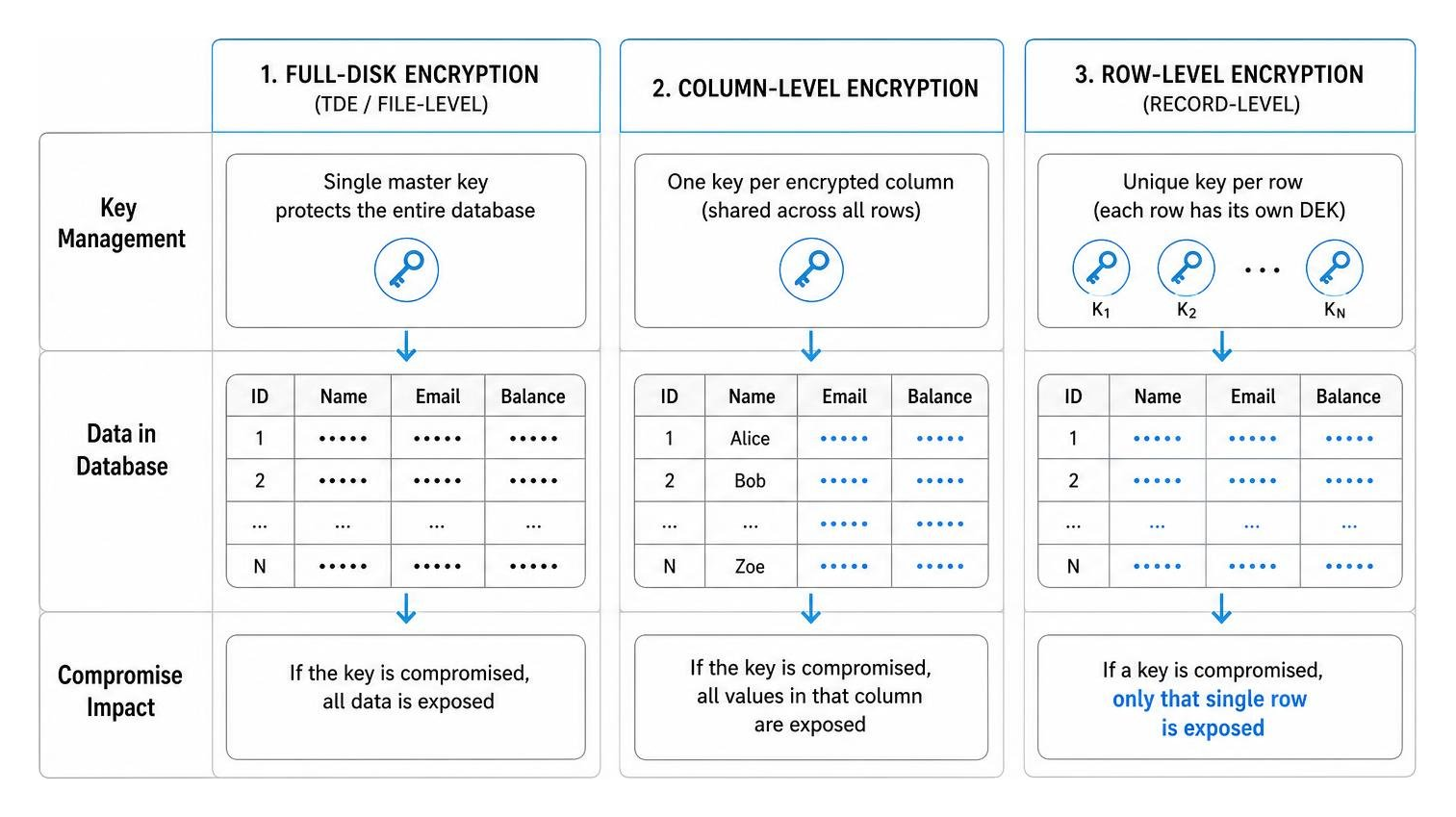
To understand why we need this, we have to look at the hierarchy of database security. Standard Transparent Data Encryption (TDE) or file-level encryption protects the physical drive. If someone breaks into your server room in California and steals your SSDs, TDE ensures they get nothing but noise. But if they exploit a SQL injection vulnerability or compromise an administrative account, the database engine happily decrypts the files on the fly and hands over the plaintext.
Column-level encryption goes a step further by encrypting specific database columns, such as credit card numbers or social security numbers. While this is useful for targeted compliance scenarios, as described in the CockroachDB Column Level Encryption guide, it still uses the same encryption key for every row in that column. If that single key is compromised, every record is exposed.
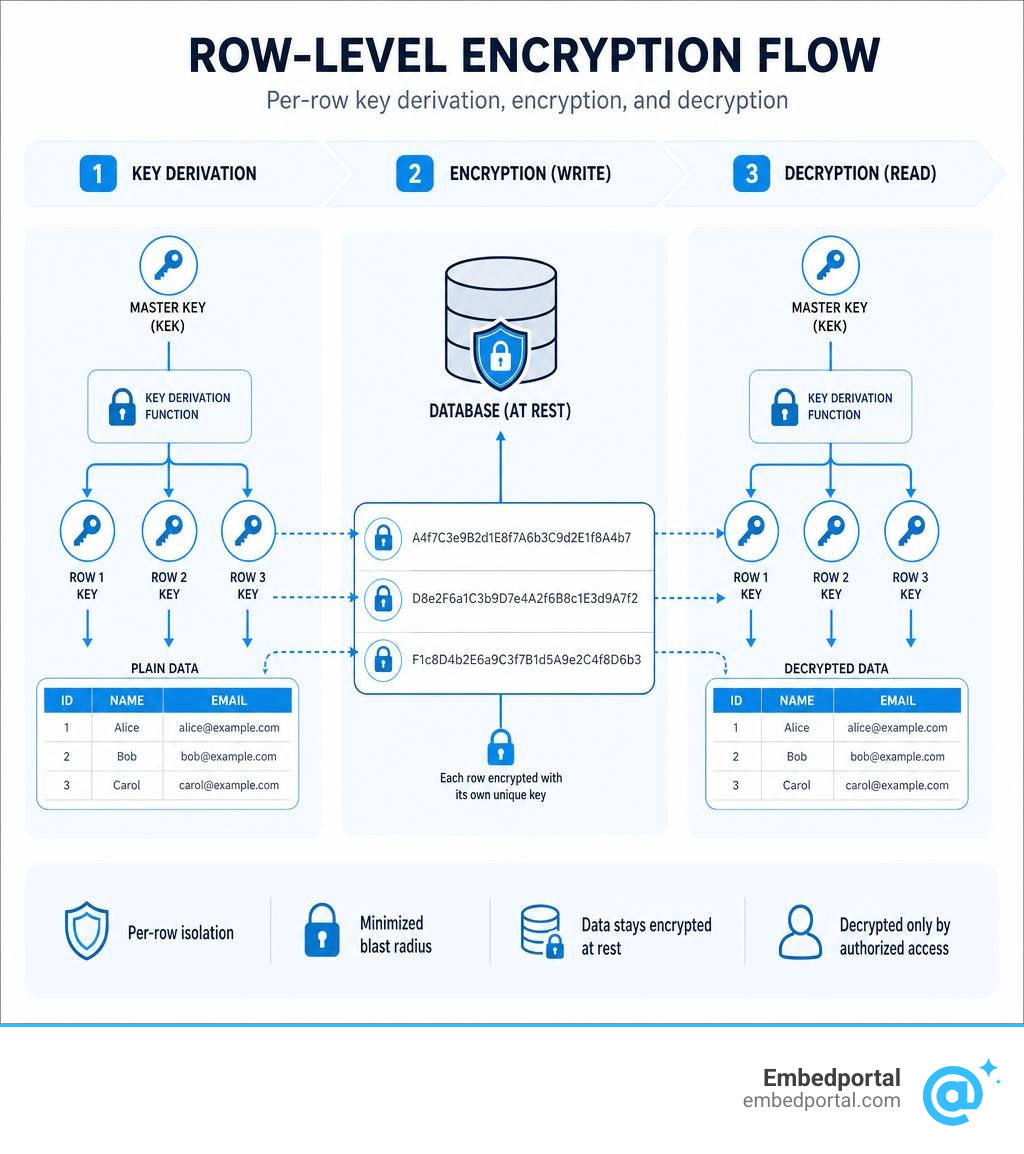
Row-level encryption (often called record-level encryption) treats every single row as its own secure enclave. In a true row-level encryption architecture, every row is encrypted with a unique Data Encryption Key (DEK). This means a breach of one record does not compromise any other record in the database. It provides defense-in-depth that keeps data safe even when the database itself is fully compromised. For a broader overview of how this concept applies across enterprise storage, you can read Record Level Encryption: A Complete Overview – Satori Cyber.
Cryptographic Architecture for Paranoids: Key Derivation and Nonce Management
If you are going to implement row-level encryption, you must design it with cryptographic rigor. A weak implementation is worse than no encryption at all because it gives you a false sense of security.
Designing a Secure Row Level Encryption Scheme
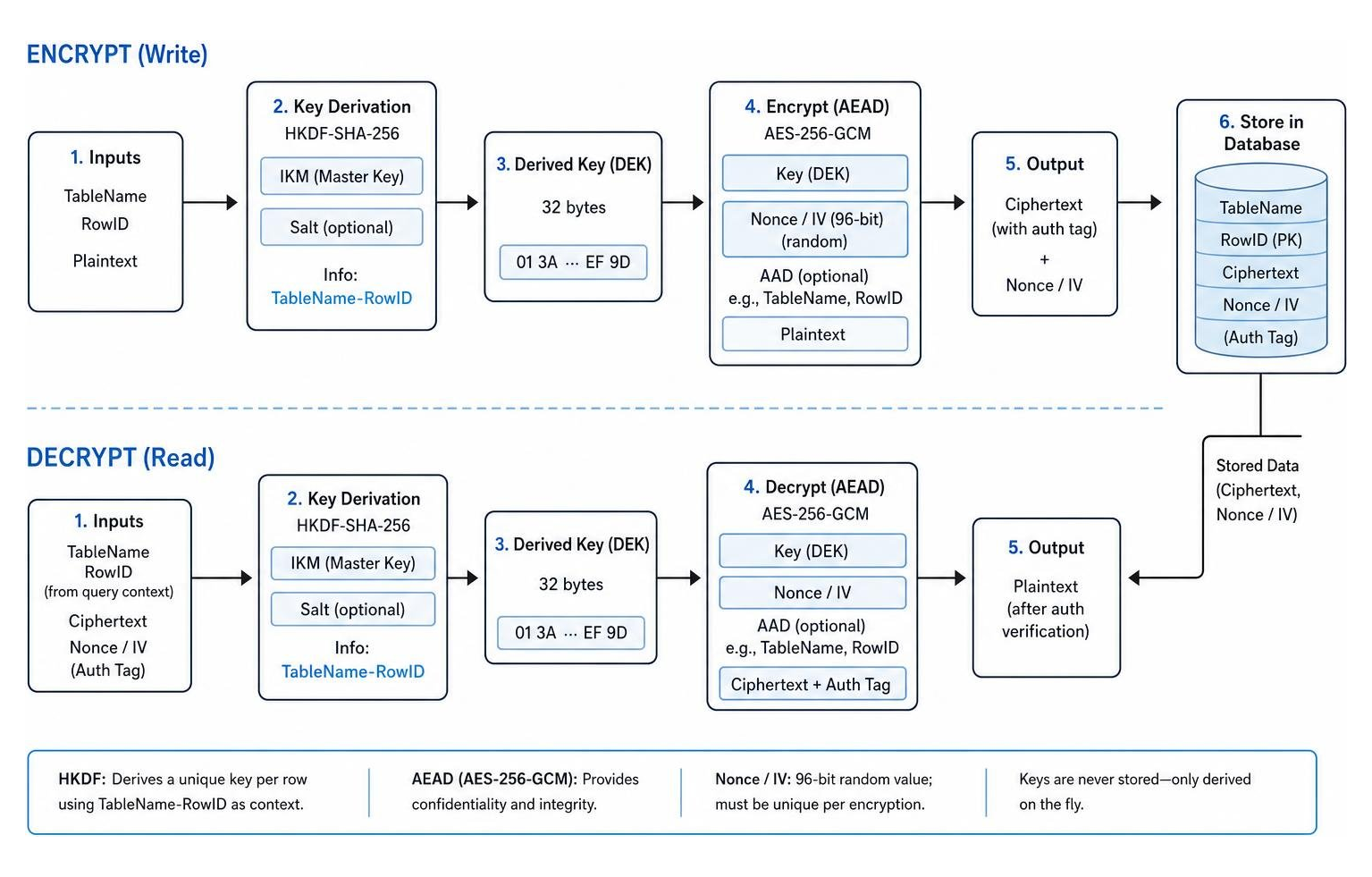
The core challenge of row-level encryption is key management. If you have ten million rows, you cannot store ten million unique keys in a database table next to the encrypted data — that defeats the entire purpose. Instead, you must derive unique keys on the fly using a Master Key and a Key Derivation Function (KDF).
The standard industry practice is to use the Hash-based Key Derivation Function (HKDF), specifically HKDF-SHA-256. HKDF takes a high-entropy master key and derives cryptographically strong, unique sub-keys for each row.
To ensure that each row gets a completely unique key, we use the row’s unique identifier (such as a UUID or a primary key ID) as part of the derivation process. In a typical Row level database encryption scheme, we use the HKDF “info” parameter to bind the key to a specific context.
For example, you can construct the info parameter as a string combining the table name and the row’s unique identifier: TableName-RowID. This prevents an attacker from copying an encrypted value from one table and placing it into another, or swapping encrypted values between rows. Because the derived key is cryptographically bound to both the table and the specific RowID, decryption will fail if the ciphertext is moved.
When setting up HKDF, you might wonder if you should hash the RowID before passing it as a salt. Cryptographers agree that this is unnecessary; HKDF already hashes the salt and info parameters internally, so pre-hashing the RowID provides no security benefit. You can leave the salt parameter optional or use a static, system-wide salt, and rely on the unique TableName-RowID info parameter to guarantee uniqueness.
Preventing Key Reuse and RowID Recycling Vulnerabilities
If you use an Authenticated Encryption with Associated Data (AEAD) cipher like AES-256-GCM — which we highly recommend — you must never reuse the same key and Initialization Vector (IV) pair. Reusing an IV with the same key in GCM mode completely destroys its security guarantees, allowing an attacker to reconstruct the plaintext.
To prevent this, you must generate a fresh, random 96-bit (12-byte) nonce/IV from a cryptographically secure random number generator (such as /dev/urandom) for every single encryption write operation. Store this IV alongside the ciphertext in the database row.
However, there is an even subtler trap: RowID recycling.
If a row is deleted and its RowID is later reused for a new record, the database might derive the exact same key for the new row if you rely solely on TableName-RowID as the info parameter. If the application also happens to reuse an IV or uses a deterministic IV generation scheme, you run into key-and-IV reuse.
To mitigate this risk:
- Avoid using auto-incrementing integer IDs that can be reset or reused after a database dump-and-load.
- Use universally unique identifiers (UUIDv4) as primary keys, as they are never recycled.
- If you must use integer IDs, include a random or time-based epoch version number in your HKDF info parameter (e.g.,
TableName-RowID-KeyVersion).
Performance, Indexing, and Operational Trade-offs
Security is a series of trade-offs, and row-level encryption demands a heavy toll in terms of performance and database usability.
The Performance Cost of Row Level Encryption
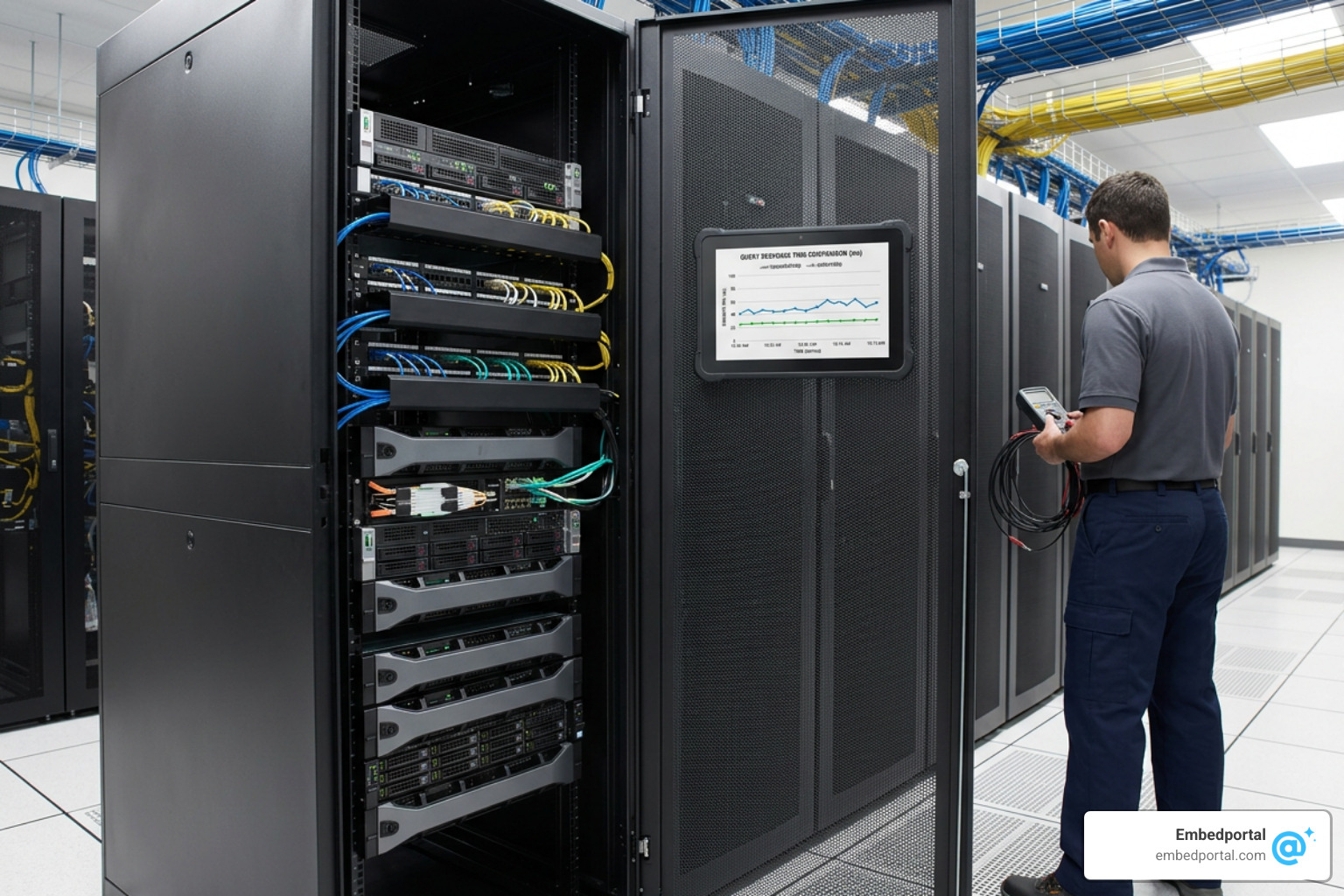
Symmetric encryption is fast, but performing it millions of times on individual records adds up. According to technical benchmarks from CockroachDB’s documentation on Column Level Encryption (and its internal file paths in src/current/v26.2/column-level-encryption.md), implementing cell or row-level cryptographic functions introduces a performance overhead of roughly 10% to 40% depending on database hardware and payload size.
This overhead comes from:
- CPU Saturation: The database server (or application server, if doing client-side encryption) must run AES and HKDF operations for every row returned in a query.
- Memory Footprint: Keeping plaintext and ciphertext in memory during bulk operations increases RAM usage.
- Query Latency: A simple select query that takes 60ms without encryption can easily jump to 100ms or more when decryption functions are applied to a large dataset.
Searchable Encryption and Blind Indexing
The biggest limitation of row-level encryption is that encrypted data cannot be indexed or searched using standard SQL queries. If you encrypt a column using AES-256-GCM, the ciphertext looks like random noise. A query like SELECT * FROM users WHERE email = 'user@example.com' will fail because the database only sees the encrypted string.
If you try to run a wildcard search (LIKE '%example%'), the database has to pull every single row, decrypt it in memory, and then perform the string match. For large tables, this will completely crash performance.
To solve this, we use a technique called blind indexing.
A blind index is a separate column containing a cryptographically secure hash of the plaintext. Instead of indexing the ciphertext, you index the hash. When you want to find a record, you hash the search term using the same key and query against the blind index column.
For example, in PostgreSQL, you can use the vibhorkum/column_encrypt extension or native pgcrypto functions to create a blind index. When a user inserts an email, the application encrypts the email into the encrypted_email column and stores HMAC-SHA256(email, blind_index_key) in the email_index column. For equality lookups, you query against the blind index column, which can be fully indexed using standard database B-Trees or hash indexes.
Key Rotation, Re-Encryption, and Compliance
A security architecture is only as good as its key lifecycle management. You must plan for the day your master key is compromised, or when compliance rules mandate a rotation.
Two-Tier Key Management: KEK and DEK
To avoid having to re-encrypt your entire database every time you rotate your master key, you should implement a two-tier key management model:
- Key Encrypting Key (KEK): This is your master key, which is stored securely outside the database in a Hardware Security Module (HSM) or a cloud Key Management Service (KMS) like AWS KMS or Google Cloud KMS.
- Data Encryption Keys (DEKs): These are the unique keys used to encrypt the actual rows.
Instead of storing the DEKs in plaintext, you wrap (encrypt) them using the KEK. The wrapped DEK is stored alongside the encrypted row data. When the application needs to read a row, it sends the wrapped DEK to the KMS to be decrypted, or decrypts it locally using a cached session key.
In advanced database setups, such as custom PostgreSQL extensions, active keys are loaded into secure memory structures like TopMemoryContext and zeroed out with functions like secure_memset when they are no longer needed, ensuring that keys do not linger in memory where they could be dumped.
Zero-Downtime Key Rotation and Batch Re-Encryption
When it is time to rotate your keys, you do not want to take your application offline. Secure systems use versioned ciphertexts to achieve zero-downtime rotation.
The key rotation process follows these steps:
- Step 1: Register the new KEK in your KMS and assign it a new version identifier (e.g., Version 2).
- Step 2: Keep the old KEK (Version 1) active for decryption purposes so the application can still read older rows.
- Step 3: Configure the application to use the new Version 2 key for all new write operations.
- Step 4: Run a background process to migrate old rows. This process reads rows in batches (e.g., 10,000 rows at a time), decrypts them using the Version 1 key, and re-encrypts them using the Version 2 key.
- Step 5: Verify the migration by running sample checks (e.g., verifying 100 random rows) before deprecating and deleting the Version 1 key entirely.
Row-Level Security (RLS) vs. Row-Level Encryption
It is common to confuse row-level security (RLS) with row-level encryption, but they are entirely different concepts that solve different problems.
- Row-Level Security (RLS) is an access control mechanism. It uses database policies and predicates to filter which rows are visible to a user based on their login or session context. For example, in SQL Server or Power BI, RLS ensures that a sales representative can only see sales figures for their own region. You can learn more about this in our guide on Multi Tenant Row Level Security.
- Row-Level Encryption is a cryptographic protection mechanism. It ensures that even if someone bypasses RLS and gains direct access to the raw database files, they still cannot read the data because it is encrypted.
As noted in the analysis on Field-Level Encryption and Row-Level Security: Why You Need Both, relying on RLS alone leaves you vulnerable to database administrators or attackers who gain superuser access. Combining both gives you the best of both worlds: RLS manages daily access controls, while encryption provides a hard cryptographic boundary.
For teams building complex analytics, managing these boundaries can get complicated quickly. At Embedportal, we specialize in helping developers embed multi-vendor dashboards with built-in Row Level Security and unified SSO, ensuring your tenant boundaries remain secure without complicating your database architecture.
Auditing, Backups, and Regulatory Compliance
Implementing row-level encryption has a massive impact on your compliance posture for regulations like HIPAA, PCI DSS, and GDPR:
- Auditing: Because decryption requires access to keys, your KMS logs become an immutable audit trail of exactly who accessed which record and when.
- Backups: Your database backups are secure by default. Even if a backup tape or cloud bucket is leaked, the data is useless without the keys stored in your external HSM.
- Log Masking: To prevent sensitive data from leaking into database transaction logs, you must enable log masking and ensure that query literals are parameterized.
- Logical Replication: If you use database replication, ensure that replication roles replicate the raw ciphertext rather than decrypting the data before sending it over the network.
Frequently Asked Questions about Row-Level Encryption
Is SHA-512 required for HKDF in database security?
No, SHA-512 is not required. While SHA-512 is computationally strong, SHA-256 provides 256 bits of security, which is more than enough to protect data for decades. Using SHA-256 is generally preferred because it has a smaller memory footprint and runs faster on standard 32-bit and 64-bit hardware, reducing the CPU overhead on your database or application servers.
Can database administrators bypass client-side encryption?
No. If you implement true client-side row-level encryption, where the encryption and decryption keys are held exclusively by the application or client, the database administrator (DBA) only ever sees encrypted binary data.
Even features like Microsoft’s Always Encrypted, detailed in Always Encrypted – SQL Server | Microsoft Learn, are designed to keep encryption keys entirely away from the database engine. While secure enclaves allow the database to perform operations on encrypted data in memory, the raw keys remain protected from administrative access.
How does row-level security impact database indexing?
Row-level security (RLS) policies add filter predicates to your SQL queries behind the scenes. This means every query has an implicit WHERE clause appended to it. If your database columns are not properly indexed to support these security predicates, query performance will degrade rapidly. To maintain performance, you must index the columns used in your RLS security policies (such as tenant_id or user_id).
Conclusion
Implementing row-level encryption is a major commitment. It requires careful planning around key derivation, performance tuning, and indexing strategies. But for security-conscious organizations handling highly sensitive multi-tenant data, the peace of mind it provides is unmatched.
If you are building customer-facing applications and need to display secure, filtered analytics to different tenants without the headache of building complex row-level filtering architectures from scratch, we can help.
At Embedportal, we provide a white-label embedding platform that allows your team to embed dashboards from Tableau, Power BI, QuickSight, and Metabase in under an hour. We handle the complex Row Level Security configurations, unified branding, and single sign-on (SSO) out of the box, so you can focus on building your core product while keeping your tenant data perfectly isolated.